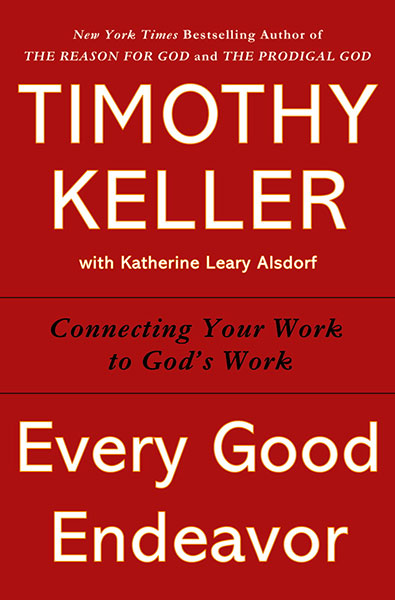
Every Good Endeavor (A Summary)
Growing up in a ministry family in the Dominican Republic, I always wanted my faith to be key part of who I was.
As I got older, keeping my faith as part of my everyday life felt more and more difficult. The pressures of family life, bills, corporate rat race, and the genuine realization of my own imperfections, distanced me from my faith.
I’ve attended churches for years during this time. I’m always surprised how little attention is given to thinking about the industries people work in during the week. Churches talk a lot about churches and theology, but often discuss little about the specific industries we work in and spend much of our time.
Every Good Endeavor by Tim Keller has +1,100 reviews on Amazon and takes this topic head on. Tim Keller is a 2x NY Times Bestselling author that has sold over 2 Million copies of his books. He published Every Good Endeavor in 2012, so while it is a recent release, it is the most comprehensive study of the topic I have found.
I took the past few weeks to read the book and summarize the most important points.
The book surprised me in two ways. First, Tim Keller was surprisingly convicting of professionals for desiring to impress others with success more than truly serving God through their careers. This prophetic edge was refreshing in an era where I find a lot of pastors are too timid to stand up to business leaders. Americans, pastors included, tend to worship money so much that business leaders often get a pass at real spiritual life.
Second, the ‘practical advice’ on approaching work was the best I’ve read. You don’t get to it until chapter 11’s “A New Compass For Work”, but its worth the wait. Its not just trite advice, but wisdom shared from real examples.
Keller didn’t spent much time on ‘business’ as a whole. He offered specific examples to professionals in higher-education, medicine, and entertainment, but then looped ‘business’ into one category. Business includes so many fields and industries like sales, finance, product development, service, or human resources, so that left me wanting.
Introduction
The book’s opening chapters build around the idea that God is a creator and because we are His people, we are also to create. “You will not have a meaningful life without work, but you cannot say that your work is the meaning of your life.” (p.27)
Keller builds on this idea that we are co-workers with God, and this is something that makes Christianity totally different from every religion on earth. “Work has dignity because it has something that God does and because we do it in God’s place, as his representatives (p.36)”, and “no other religion envisions matter and spirit living together in integrity forever (p.39).”
The future of matter and spirit living together in integrity is beautiful, but it can only come to fruition through work. “God made the world to need work. He made it such that even he had to do work for it to become what he designed it to be, to bring forth all its riches and potential. (p.46)

To explain what work is, Keller explains that “work is the form in which we make ourselves useful to others… The difference between a wilderness and a culture is simply, work (p.66).” So, one of the first ways we can be a Christian in our workplaces is simply to be competent. “The church’s approach to an intelligent carpenter is usually to exhort him to not be drunk or disorderly on his leisure hours and to come to church on Sundays. With the church should be telling him is this: that the very first demand his religion makes on him is that he should make good tables. (p.67)”
Dorothy Sayers is referred to often in this book, and her idea to “serve the work” is powerful. Keller quotes Sayers talking about how so many people want to go into Community Service, but what happens is people begin to want payback and recognition for the great work of community service they have done. However, when they ‘serve the work’, they know they get nothing in return, but the work itself is the reward. “the work takes all and gives nothing but itself, and to serve the work is a labor of pure love… It is the work that serves the community; the business of the worker is to serve the work. P.105”
This topic gets into the central idolatry that many people in the workplace struggle with which is to want to impress man rather than God. Keller casts a new vision where “the two things we all want so desperately – glory and relationship – can coexist only with God. p.111”
This worldview enables Keller to come up with these ideas:
How Christians are to work (p.221):
- Work is to be done with all your heart and might, as skillfully as you can, and it should not feel like a burden, but a privilege.
- We do not work hard only when being watched; nor do we do only what is necessary to get by.
- We look to an audience of one, our loving heavenly Father, and that gives us both accountability and joy in our work.
How Christians Are To Be Known (p.224):
- Christians should be known not to be ruthless.
- Christians should be known to be generous.
- Christians should also be known to be calm and poised in the face of difficulty or failure.
- Christians should not be seen as sectarian.
Conclusion
One final call to action for Christians from Keller is to wrestle through the implications of our specific industries or fields as it relates to human well-being and justice. (p.232)
The book inspired me to think about the areas of idolatry and people-pleasing I have in my professional life and inspired me to find joy in the duty of work rather than the fruit that is generated from it. It made me want to make my industry better, make more real connections with collaborators, and to be intentional every step of the way.
If you enjoyed this content, subscribe here to my newsletter to receive future articles.
 Joshua Ballantine