
A few years back, I was in a Bible study class in my home, evangelical church in Chicago. The leaders had invited a “missionary” family that was from Chicago and serving in Costa Rica. The family seemed nice enough until they started saying racist things about Latinos and complaining about the culture.
I was 12-years old when my parents moved to Latin America as protestant missionaries, so this episode made me reflect on my childhood. What possibly paternalistic, racist behaviors did I also carry like these missionaries? And what really is “missions” for protestant Christians if we are taking our faith to Latin America that is already made up only of Christian countries with vibrant faith communities? This is a story of Catholics and Protestants, and an explanation of what I think missions really is.

Since I am much more familiar with Protestant missionaries, I wanted to first find an expert on Catholic missionaries, which I found in Peru. Professor Juan Miguel Espinoza is a Catholic researcher from Boston College and Professor at the Catholic Pontificate University of Peru.
When I interviewed him, he had mostly positive things to say about the history of missions. He told me about Catholic saints I never heard of like San Pedro Claver who fought against slavery in Colombia, Antonio Ruiz Montoya who defended indigenous tribes in Peru, or the Jesuit priests that fought alongside the Guarani in Paraguay against the Portuguese Slave Traders as depicted by Robert Deniro’s 1986 film, The Mission. He had plenty of positive things to say about the protestant missionaries as well (mostly American) who helped bring good education systems to Latin America.
“The difference with missionaries in the colonial age is that they left never to return. It was permanent.” Said Professor Espinoza. “It is also unique that an ‘autonomy’ is created for the missionary from the missionary’s home church.”
The problem for him with missionaries was when they began to see their relationship as ‘vertical’ rather than ‘horizontal’. Missionaries were often so focused on whether someone was ‘converted’ rather than seeing the holistic person and how Christ’s message could bring them liberation.

I found Protestant missionaries working in Latin America typically to have a vertical relationship to their converts rather than horizontal. I don’t doubt the sincerity of their faith, but I wonder about the reason for their work when they choose to serve in a country with a vibrant, Catholic faith. If they are not missionaries, what are they?
The liberal replacement of the word “missionary” could possibly be “organizer”. Any cross-cultural missionary can relate to the life of someone like Barack Obama who was born in Hawaii, raised in Indonesia, and blended his life across multiple cultures and races in service.
Long before he became the icon he is today; he wrote about his efforts to be an “organizer” in Chicago in his biography, Dreams of my Father. He found that the people he was “supposed to be organizing” actually “carried with them some explanation of themselves” that he was missing. Obama was missing something and found part of that in the people he was serving and organizing. “We are tarnished by the desire to find in the other some element that was missing in ourselves.” It was not a one-way relationship, but a two-way relationship that augmented his life. He even married someone from the community where he served in Chicago and calls the community his home, although he never lived there until late in his 20s.
From a Christian perspective, we believe we are broken people in need of a savior. I realized from this missionary couple that spoke at my church that they are broken people as well. They are really in Costa Rica looking for some element of life that is missing in themselves. However, they chose to respond to trials that come as a “missionary”, or living cross-culturally, with bitterness and negativity. There must be a better way.
Professor David Hollinger from UC Berkeley brings a new point of view to the purpose of missionaries which can be deducted simply from the title of his book “Protestants Abroad: How Missionaries Tried to Change the World but Changed America”.
In an email with Professor Hollinger, he explained some of the mistakes evangelical and protestant missionaries made in entering Catholic countries, “Protestant missionaries saw much to lament from Catholic missionaries and little to admire. They paid little attention to them at all.” This is unfortunate because there was so much to be learned from the good of Catholic missionaries, not just the bad.
Why Are There More Missionaries and Less Converts?
Statistical estimates suggest that in percentage terms “the Christians accounted for a slightly lower percentage of the world population in 2000 than they did at the beginning of the century,” according to Brian Stanley’s Christianity in the 20th Century. Yet, at the same time, between 1970 and 2000, the number of foreign Christian missionaries worldwide almost doubled according to Gordon-Conwell’s Center for the Study of Global Christianity.
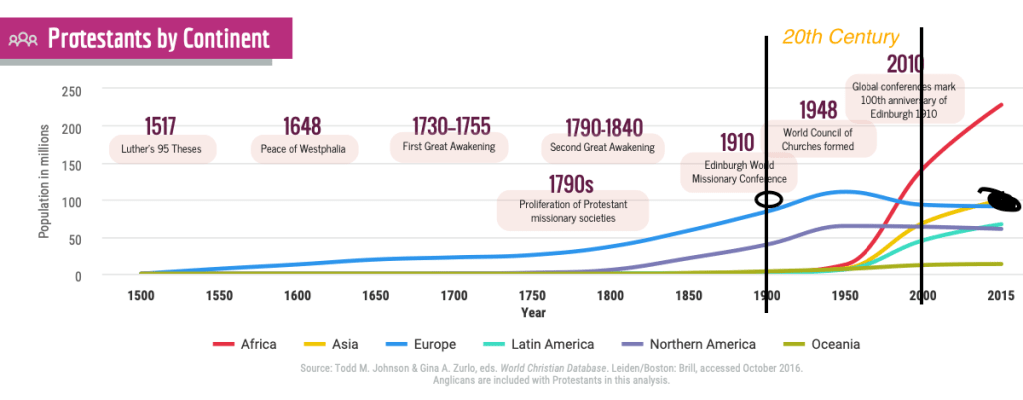
Based solely on “soul count”, this would infer that missionaries in the 1900s completely failed. However, Professor Hollinger argues that American missionaries saved the American church at home. “Their experience abroad made many of these missionaries and their children critical of racism, imperialism, and religious orthodoxy.”
Missionaries are not in an exercise to save souls from other countries, they are on an adventure to open themselves to God to save their own souls and the souls of the churches that send them. As broken people, there is something missing inside of us that only God and the people we are serving can replace. Maybe we are like alcoholics whose “very lives, depend upon our constant thought of others and how we may help their needs.” (Alcoholics Anonymous Big Book)
Whether we consider ourselves missionaries, organizers, or just people who want to serve others that are different from us, we will always have a choice when we face difficulties to become embittered and egotistical, like the missionaries from Costa Rica, or have our life augmented by the people we are supposed to be serving. Because really, we are the ones being served.
If you enjoyed this content, subscribe here to my newsletter to receive future articles.
 Joshua Ballantine