The higher I go in my career, the more important writing has become.
Early in my career, I had to focus on one-on-one communications like cold calls, client complaints, or emails to my boss.
Now, I’m scaling my work. Even as an individual contributor, my account team often is made up of up to 15 people internally working on new sales opportunities. We’re selling extremely complex sales cycles to the largest companies in the world. We have to tell stories to executives who are bringing large-scale business and digital transformation to their companies.
My customers and internal teams have their own families and career goals. They are busy professionals, so I have the responsibility to make every email succinct, clear, and strong.
Business writing is extremely important. In this article, I will share a few types of business emails that are important in my account executive role and some real world examples of those emails.
But before we go to my emails, here is the best resource for business writing online I have found, here is a great blog about teaching ‘founders’ to write, here are dozens of real-world business writing examples, this is an amazing twitter account of famous tech executives and their actual emails that were leaked, and this is a great framework course for becoming a stronger business writer from a founder I respect: “Do – Learn – Do“.
Cold Emails of High-Ranking People
Sales, of course, is filled with massive amounts of cold emails. One of the best forms of writing you can learn in business is the cold email. This skill is closely related to copywriting because the reader does not necessarily want to read it.
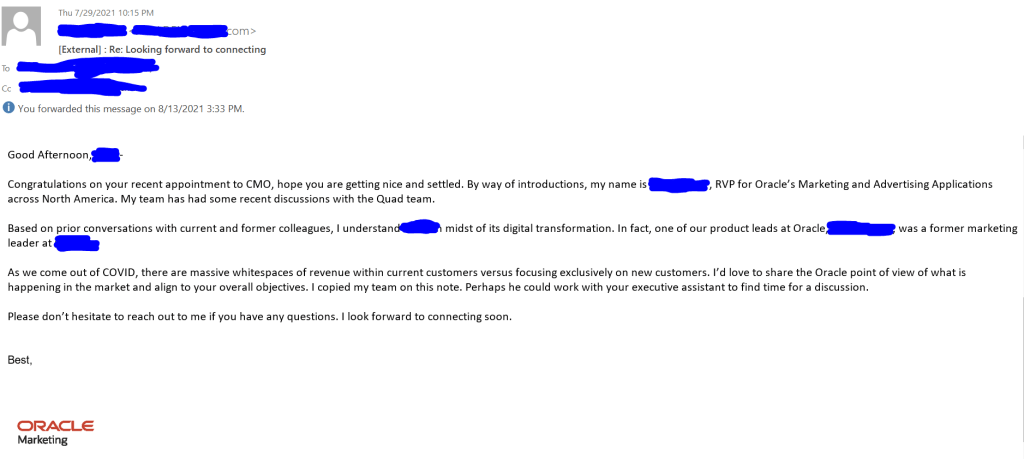
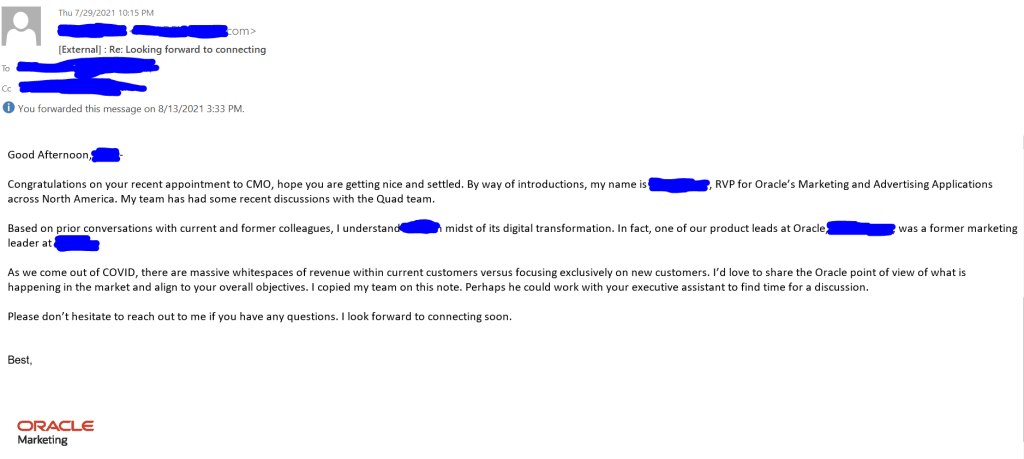
Below is a recent email I sent to the CMO of a Fortune 500 company that generated $1.5 Million in revenue pipeline to a greenfield account Oracle had no relationship with. Here is the email:
Now, here was the response:

Its important to note I wrote this as a ‘ghost note’ for one of my executives at Oracle to send directly to the CMO. This is a common practice at large companies that has a lot of success. Executives love speaking with other executives. I write the email then share with my VPs to send directly. Here are the things to notice about the cold email:
- Know the person: In the first sentence I affirmed their appointment as CMO. Its exciting when I get promoted or when I get an exciting new role, it shows I have momentum. In this note, I want to be part of the momentum the executive has created. Success begets success.
- Know the account: I talk about my previous conversations with the account, and someone at Oracle that used to work at this company. We really don’t have much information, but we confidently used what we had.
- Assume you have a point of view: I have a point-of-view for every account about their business transformation and where they should be headed. That’s why I’m telling the customer in this email that I want to share my point of view. While it really will be a ‘discovery’ meeting for me to find out how they will need to get budget for software and how long it would take, I will never get that information without a strong point of view.
- Talk about revenue opportunities: Executives exist to bring stronger business opportunities to their companies. In this email, I’m using the language of “massive whitespaces of revenue” available by focusing on current versus new customers. I’m giving a little bit of my point of view, but not everything.
- Team Approach: Executives are running a team. We think of them as individual people, but they want to empower their team. I assume every executive as an executive assistant (EA) that will schedule our meeting for us. I act like I’ve been here before and directly ask to speak with their EA to schedule the meeting. I also explain that I’m also over a team. It shows that we care about the potential account by having a whole ‘team’ as nebulous as what that even might be.
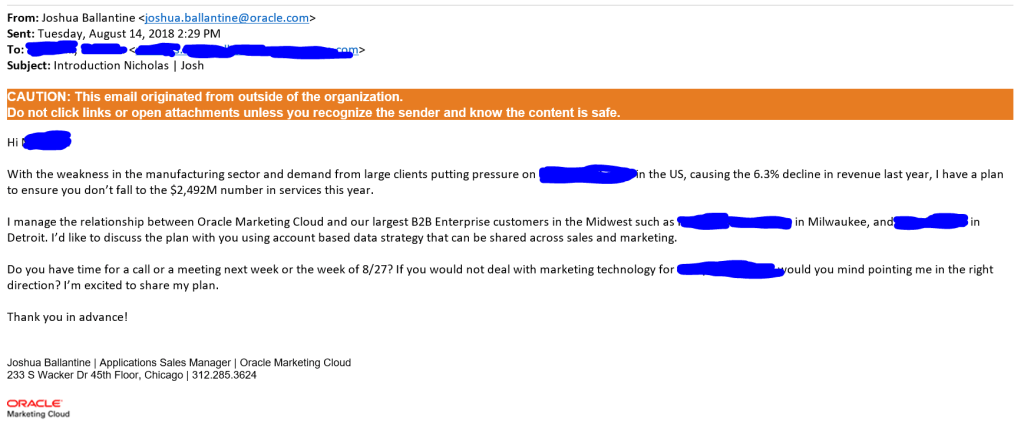
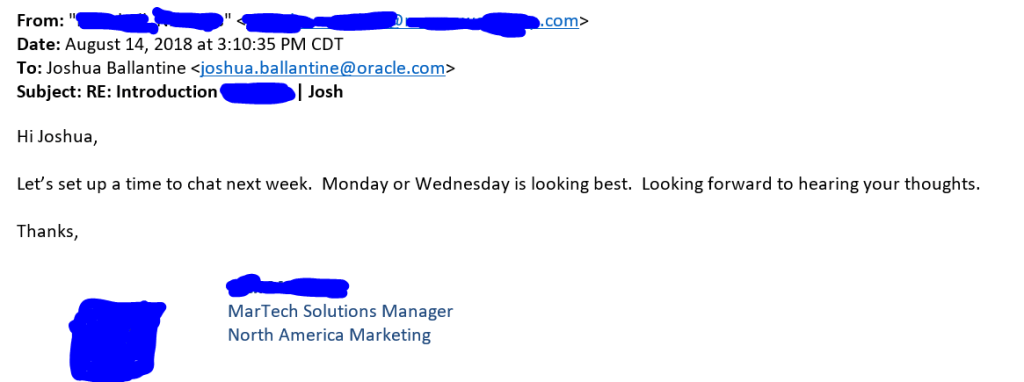
Another Successful Cold Email Example:
Meeting Agendas
Amazon requires employees to forego PowerPoints and instead provide a ‘briefing document‘ for attendees to read at the beginning of every meeting.
Many salesman are the leaders of their meetings, so it is important to share an agenda and point-of-view on what will be discussed during the meeting. I like to send mine the night before or morning of the meeting.
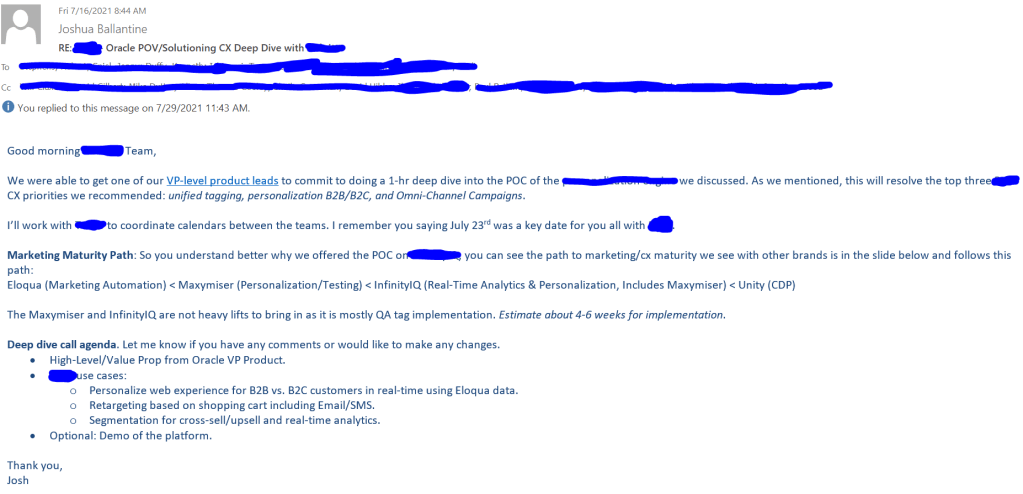
Here is an example of an agenda I sent to a System Integrator for a meeting concerning our shared customer.
Meeting Follow Ups
One of the most important values to build a business career is trust. I like to hold myself to the standard of “doing what I say I’m going to do” even with the small things. If I say I will follow up Monday, I write it on my calendar that I must follow up Monday, no exceptions. Even small things like a simple meeting follow up. Here is an examples of a meeting follow up I did for a customer recently and some things I pulled from it.

- Meeting Follow Ups Have a Long Life: For salespeople, a meeting follow up is often ‘ground zero’ for the entire relationship. This email will be shared and forwarded for a long time.
- Be Useful: You’ll see in my email above, I’m sharing actual org structure examples of how my customer can be better at their role. I sell software, not strategy services. However, my experience in the industry is useful to them based on what I’ve seen with other customers.
Team Alignment and Celebration Emails
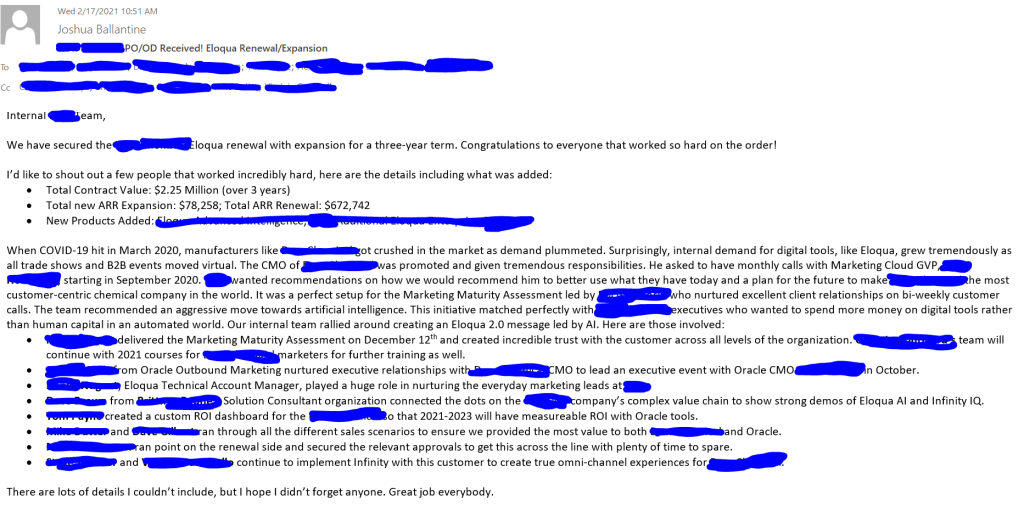
Work can be hard, so its important to celebrate our victories. Most people don’t get commission, so often don’t get to taste the victory in the same way as executives or salespeople. Here is an example of a an email I sent to the team to celebrate a big win that our account team had.
If you enjoyed this content, subscribe here to my newsletter to receive future articles.
 Joshua Ballantine